

Southern Baby Clothes: A Complete Guide for Parents
You're standing in the baby aisle or scrolling from your couch, trying to decide whether that adorable Southern-themed outfit is a sweet gift or just one more thing that'll sit unworn in a drawer. Maybe a grandparent picked out a tiny patriotic onesie, maybe you're planning a church photo, or maybe you just want your baby to look like they belong to your family, your place, and your season without sacrificing comfort. The tricky part is that southern baby clothes have to do two jobs at once, they need to feel like home, and they need to work for a newborn's skin, sleep, heat, growth spurts, and constant messes.
Table of Contents
- What Every Parent Should Know Before Shopping
- Defining the Southern Baby Clothes Niche
- Fabrics and Safety Standards That Matter Most
- Sizing and Fit Without the Guesswork
- Coordinating Family Looks for Every Occasion
- Spotting Small-Batch and Handcrafted Quality
- Care and Washing Tips That Protect the Graphics
- A Smart Shopping Checklist Before You Buy
What Every Parent Should Know Before Shopping
The fastest way to get overwhelmed is to treat a baby outfit like an adult T-shirt in miniature. A lot of Southern-themed pieces look simple on the hanger, but once a baby is involved, the essential questions change fast: does it breathe, does it fit safely, will it still look good after washing, and can it handle heat, diaper changes, and car seat time?
Start with the baby, not the theme
A cute graphic matters less than the body wearing it. If the outfit is for a July baby, a heavyweight fabric or a fussy layered look can turn into a comfort problem before you leave the house. Trusted baby-care guidance puts the emphasis on fit, breathable fabrics, temperature control, and avoiding hats, hoods, cords, and overdressing, especially in hot weather or during sleep, which means the best Southern look often starts with a plain, soft base layer and adds only what the weather allows. See the practical guidance on newborn dressing from Pregnancy, Birth and Baby.
That's why the “first outfit” question is bigger than style. A grandmother may be thinking about the memory, a parent may be thinking about the photos, and both can be right. The best purchase gives you both: a look that feels distinctly Southern and a construction that won't irritate newborn skin or force you into a return.
Practical rule: if you wouldn't want the baby sleeping in it, sitting in it, and being held in it for a long stretch, it probably isn't the right everyday outfit.
Know what this niche actually includes
Southern baby clothes usually pull from the same visual language you see in adult Southern apparel, patriotic motifs, faith-based phrases, camo, farm and outdoor graphics, regional pride, and small-town imagery. Those ideas translate naturally into onesies, rompers, creepers, longalls, and take-me-home outfits, which is why the niche feels familiar even when the garment size changes.
The rest of this guide focuses on the questions parents ask after the excitement wears off. What counts as Southern? Which fabrics and certifications matter? How do you read the size tag? What should you check before checkout? Those are the questions that save time, money, and a lot of second-guessing.
Defining the Southern Baby Clothes Niche
A Southern baby outfit is usually easy to recognize before you ever read the product description. The print tells you most of the story. You'll see flags, stars, scripture-inspired wording, camouflage, duck or deer graphics, tractors, barns, monograms, and hometown or regional references. On a product page, those details are the visual shorthand for heritage, faith, freedom, outdoor life, and family identity.
The design language shoppers usually see
The niche isn't just one style. It's more like a set of overlapping themes.
- Patriotic pieces often lean on flags, stars, red-white-and-blue color stories, and holiday-specific styling.
- Faith-based designs may use scripture phrases or gentle devotional language.
- Outdoor and hunting motifs bring in camo, deer, ducks, boots, and field-inspired colors.
- Farm and small-town graphics usually feature tractors, barns, sunflowers, or simple country icons.
- Regional pride pieces may reference the South directly, through names, sayings, or local cultural cues.
That's why a baby onesie can feel Southern without being loud. A subtle regional graphic can do the job just as well as a full holiday print, especially if you want something the baby can wear beyond a single event.
Why this market exists at all
The modern baby-clothing market is large enough to support identity-driven design at scale. A 1995 Los Angeles Times report on the U.S. baby-clothes industry put the category at $5.5 billion, and that number already reflected a mature mass-market business, not a novelty corner of retail. Historical fashion research also shows that children's clothing became a distinct industry in the mid-1800s, and ready-to-wear manufacturing made purpose-designed children's garments widely affordable in the early 1900s.
That history matters because it explains why today's Southern baby lines can exist in the first place. The market can support themed garments, coordinated family pieces, and standardized sizing without making baby clothes feel custom-made or out of reach. By the late 1700s, children were already dressed differently from exact miniature adults, which created the cultural space for age-specific babywear and, eventually, themed infant lines.
Fabrics and Safety Standards That Matter Most
Southern style only works when the fabric works. In hot weather, on a sleeping baby, or under a blanket during a church visit, the wrong textile can make a cute outfit feel like a bad idea very quickly. For newborns, the best starting point is usually lightweight cotton, cotton blends, and soft knits that let air move and don't feel stiff against skin.
Fabric choice should follow the season
The South brings heat, humidity, and quick weather changes, so fabric choice matters more than decorative detail. A thick print or heavy layer can trap warmth, while soft cotton tends to handle everyday wear more comfortably. For sleep and long stretches in a car seat, simple construction usually beats extra embellishment.
The safest mental filter is basic, not fancy. Ask whether the outfit is soft, breathable, and easy to layer. If it comes with cords, oversized hood pieces, or accessories that sit close to the face, think twice, especially for a newborn or sleeping baby. Trusted newborn guidance prioritizes loose comfort and temperature control over decorative extras, and that's a useful rule for themed outfits too.
Two labels that matter on product pages
The first technical benchmark is the CPSC infant-garment definition. In the U.S., CPSC defines an infant garment as size 9 months or smaller, with a one-piece length not exceeding 64.8 cm (25.75 in.) or a two-piece piece no longer than 40 cm (15.75 in.), and those garments must comply with flammability rules in 16 C.F.R. parts 1610 and 1611 while carrying a size label expressed in months, according to the CPSC FAQ on infant tight-fitting garments. That means a Southern-look romper or creeper can trigger infant-specific compliance rules based on size and construction, not just on how it looks.
The second is OEKO-TEX® STANDARD 100 Class I, the strictest class for babies and toddlers up to age three. It involves testing for over 1,000 harmful substances, as explained in Gerber Childrenswear's overview of OEKO-TEX® STANDARD 100. That kind of certification matters most for bodysuits, creepers, and take-me-home outfits, because those pieces stay in close contact with skin.
Parent check: if the garment is close-fitting, sized in months, and meant for a baby under one year, read the safety labeling before you get attached to the print.
Sizing and Fit Without the Guesswork
Baby sizing feels confusing because the label doesn't behave like adult sizing. A “3 months” or “6 months” size isn't a promise about age so much as a shorthand most brands use to organize infant clothing. That's why two outfits labeled the same way can still fit differently, especially if one is cut more generously or made for a different use case.
Use the label as a starting point, not the answer
A size tag gives you a rough lane, not a guarantee. The smarter move is to compare the baby's current measurements against the brand's size chart before you buy, then look at how the garment is built. If the child is between sizes, many parents choose the roomier option so the outfit lasts through diaper changes and one more growth spurt.
The CPSC definition helps here too. Infant garments can fall into regulated territory based on size and construction, so sizing isn't just a comfort issue, it can be a compliance issue as well. That's why a baby longall, romper, or creeper should be checked for both fit and label clarity.
A quick fit routine you can repeat every time
Before washing, check these points:
- Sleeves should clear the hands. If they cover the fingers, they're too long for practical wear.
- Necklines should sit comfortably. They shouldn't choke the chin or gape open.
- Snaps should land below the diaper line. If you have to tug hard to close them, the fit is off.
- Inseams should allow movement. Tight leg openings can make crawling, kicking, and diaper changes miserable.
If the brand offers a size chart, measure the baby and compare it before checkout, then re-check after the first wash because some fabrics shift slightly. That's especially helpful for coordinated sibling pieces, where one child can be in a cleanly fitted outfit while the baby still has room to grow.
You can also watch a product walkthrough here:
For outdoor-specific family styling, this kids outdoor clothing guide is a useful companion when you're trying to match babywear to older siblings without overcomplicating the look.
Coordinating Family Looks for Every Occasion
The strongest Southern baby outfits usually work because they feel like part of the family, not because they're packed with details. A coordinated look can be quiet and still feel intentional, especially when the baby's piece is the softest, simplest version of the whole outfit. That approach also makes the baby more comfortable, which matters more than matching every accessory.
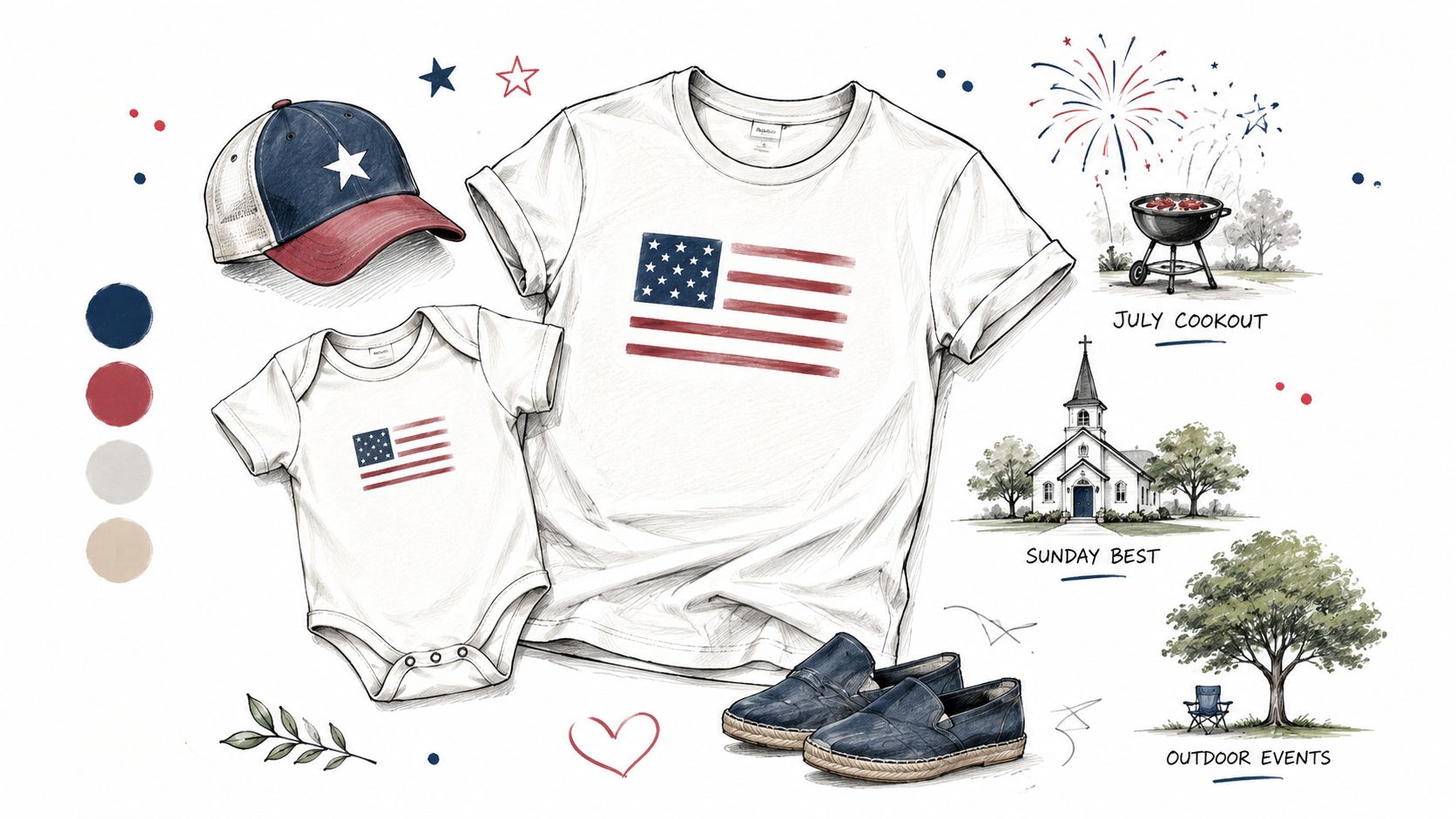
Three real family situations
For a patriotic July pairing, the baby can wear a breathable onesie with a small flag graphic while older siblings wear matching tees and adults keep the palette coordinated with denim, white sneakers, or simple hats. The baby doesn't need extra layers to “complete” the look, because the family connection already does the work.
For a hunting-season look, a baby romper or bodysuit with a camo accent reads clearly without copying the adult outfit too closely. A parent's jacket, a sibling's tee, and a neutral beanie can echo the theme while keeping the baby piece light and wearable.
For a Sunday-best set, the smartest choice is often the most restrained one, a soft take-me-home outfit or bodysuit with a subtle heritage detail. If the family is dressing for church, photos, or a meal afterward, the baby should be able to rest, be held, and stay comfortable without decorative extras getting in the way.
Why less decoration often works better
Baby-care guidance favors lightweight fabrics, loose comfort, and sun protection outdoors, not accessories that look pretty but complicate care. That's why a plain cotton bodysuit with a modest Southern graphic can beat a more ornate outfit that rides up, overheats, or needs constant fixing. In practical terms, the best Southern baby outfit is often the one a tired parent can put on quickly and trust all day.
Spotting Small-Batch and Handcrafted Quality
Small-batch baby clothes can feel more special, but the label alone doesn't tell you much. A real handcrafted piece usually shows its work in the construction, the print finish, and the way the brand handles its collection. Mass-market basics, by contrast, usually aim for consistency, speed, and broad availability.
What to look for on the garment itself
A better-quality small run often has a more deliberate feel. The print may sit cleaner on the fabric, the stitching may look more intentional, and the overall collection may be smaller and more cohesive. If the brand offers parallel adult and baby pieces, that can be a sign of a carefully built family line rather than a random seasonal print.
A useful way to judge value is to ask whether the outfit can live past the first photo. If the fabric is sturdy enough for repeat wear and the graphic is subtle enough to mix with other clothes, the piece has hand-me-down potential. That matters in a category where many parents now prefer reusable, less gender-coded clothing over single-occasion novelty buys.
Quality cue: the best small-batch baby item isn't always the most ornate one. It's the one that still feels useful after the first event is over.
Compare it like a parent, not a collector
The small-batch production guide is useful if you want to understand how handcrafted positioning usually shows up in a product line. What matters for parents, though, is simpler. Ask whether the piece can rotate with neutral basics, whether the colors feel durable, and whether the theme is strong enough to read clearly without needing extra accessories.
That's where Southern baby clothes can be surprisingly practical. A coordinated graphic can still be versatile if it stays clean, repeatable, and easy to wear across more than one setting.
Care and Washing Tips That Protect the Graphics
A baby outfit survives because the care routine is simple enough to repeat. If you have to remember too many steps, it won't happen on a busy weeknight. For Southern-themed baby clothing, the easiest habit is to wash the garment inside out, use cold water, and keep heat low.
A repeatable wash routine
Start with the print side protected. Turning graphic onesies inside out reduces friction on the design, and cold water is gentler on both fabric and color. When the cycle ends, air-drying is the safest choice for preserving the print, while a low tumble setting is the backup if you need speed.
Use a mild detergent that's appropriate for infant skin, and skip fabric softeners on pieces that are moisture-wicking or designed with special performance qualities. Those finishes can lose function when the wrong product coats the fibers. The same rule applies to flame-resistant items, where buildup can interfere with what the garment is supposed to do.
Treat the real messes fast
Southern-baby messes are usually predictable. Grass, sunscreen, and barbecue sauce all happen fast, and they all get harder to fix if they sit. Dab, don't rub, and get the stain out before it sets into the print.
- Grass stains: rinse the area quickly and wash before the mark dries.
- Sunscreen: pre-treat gently, since oily spots can linger on light cotton.
- Barbecue sauce: lift excess first, then wash as soon as possible.
For a quick visual refresher on print care, see the graphic tee washing guide. The same logic applies to baby graphics, only more so, because babywear tends to live closer to skin and needs gentler handling.
A Smart Shopping Checklist Before You Buy
A good Southern baby outfit should pass three tests at once. It should feel connected to your family's style, it should be comfortable enough for real baby life, and it should be built in a way that makes sizing and washing manageable. If one of those pieces is missing, the outfit usually becomes a regret purchase.
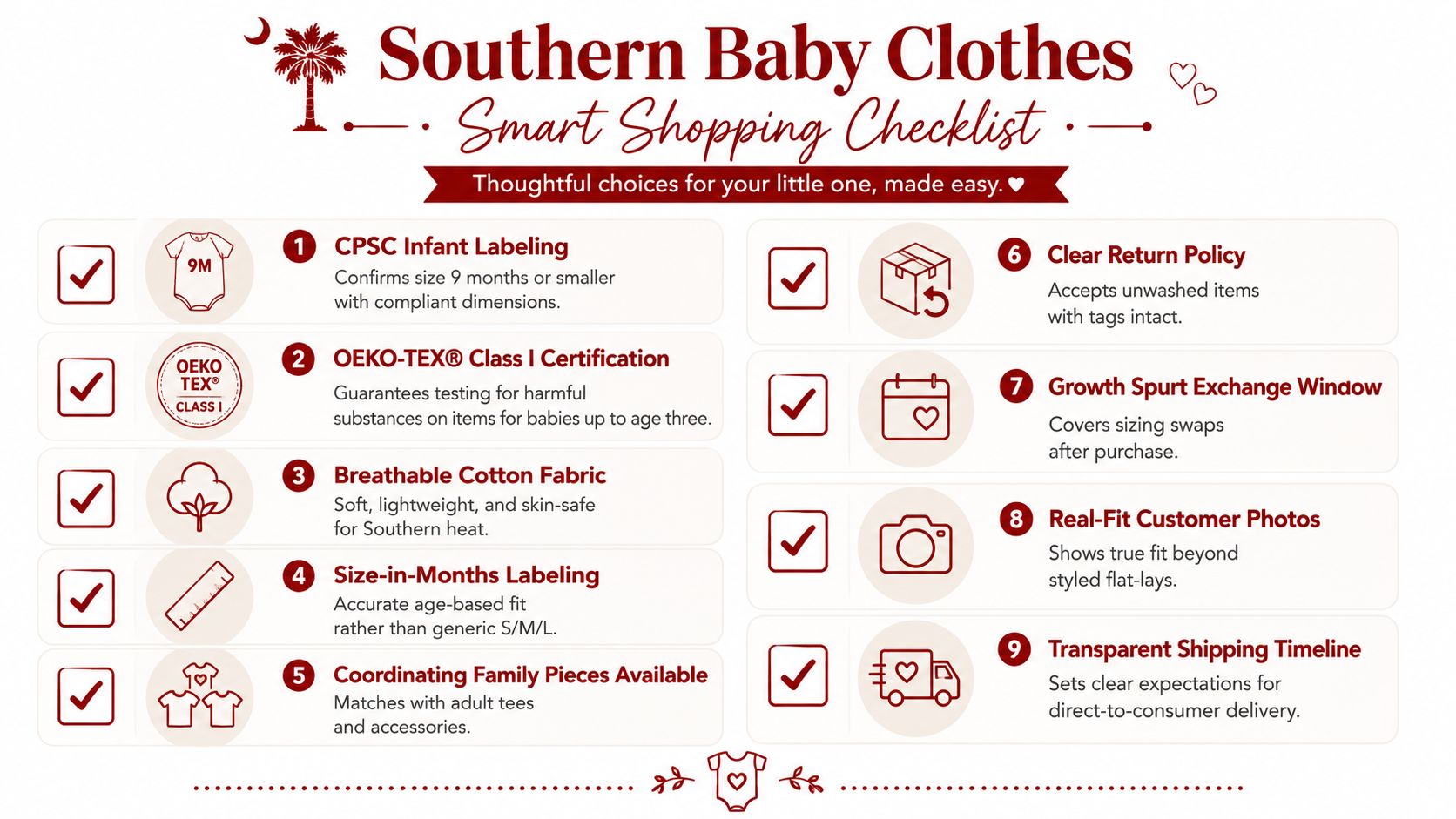
Quick-reference checklist
| Check | What to Look For | Why It Matters |
|---|---|---|
| CPSC infant labeling | Size 9 months or smaller with compliant dimensions | Helps confirm the garment sits in the right infant category |
| OEKO-TEX® Class I certification | Testing for harmful substances on baby-contact items | Adds confidence for close-to-skin wear |
| Breathable cotton fabric | Soft, lightweight, skin-friendly material | Better for Southern heat and everyday comfort |
| Size-in-months labeling | Clear age-based sizing | Makes comparison easier than generic S/M/L labels |
| Coordinating family pieces available | Adult tees, kids' shirts, baby bodysuits, hats | Makes family matching easier without forcing exact clones |
| Clear return policy | Unwashed items with tags intact | Protects you if fit or style isn't right |
| Growth-spurt exchange window | A reasonable swap period after purchase | Gives you room if baby sizes up quickly |
| Real-fit customer photos | Babies and parents wearing the item naturally | Shows how the piece fits outside styled flat-lays |
| Transparent shipping timeline | Clear DTC delivery expectations | Helps you plan for events, photos, and gifts |
The five-minute check that saves the most trouble
Before you click buy, read the size chart, look for breathable fabric language, check the return policy, and decide whether the piece is meant for one event or repeat wear. If you're buying for a gift, confirm that the baby sizing matches the season, not just the photo. If you're buying for your own child, look for room to grow and enough softness to wear all day.
The best Southern baby clothes balance identity, comfort, and safety without making you choose between them. Use the checklist once, and it starts saving you returns, rashy skin, and those little “why did I buy this?” moments that show up after the package arrives.
A CTA for Southern Static Clothing Company. If you're ready to shop Southern baby clothes with a clearer eye, browse the baby collection first, then compare the family pieces, fabric feel, and size-in-months details before you order.