

Faith Based Home Decor: A Southern Heritage Guide
You're likely standing in the middle of a room that feels almost right. The sofa is in place. The rug works. The lamps are warm. But the parts of your life that matter most, your faith, your family story, the way your people have always made a house feel like home, still aren't showing up in a way that feels natural.
That's where most folks get stuck with faith based home decor. They don't want a house that feels like a gift shop display. They don't want every wall shouting. They also don't want to hide the very thing that steadies them. What they want is a home with conviction and grace. A home where scripture, memory, hospitality, and Southern heritage sit together as comfortably as cornbread on a Sunday table.
There's good reason more people are paying attention to this category. The global faith-based products market reached $12.3 billion in 2025, with home décor and jewelry making up 70% of the top-selling categories, and the artifacts and accessories segment accounted for about $5.8 billion in revenue, according to Alibaba's faith-based products market overview. That tells me this isn't some passing novelty. People are trying to make their homes reflect what they believe.
Table of Contents
- Creating a Home That Tells Your Story of Faith
- What Is Southern Faith-Based Interior Style
- The Key Materials and Motifs of Heritage Decor
- Styling Your Faith Room by Room
- Decor as Discipleship and Hospitality
- Sourcing and Crafting Your Decor
- Placement and Care for Your Cherished Pieces
Creating a Home That Tells Your Story of Faith
A faithful home doesn't begin with a cross on a wall. It begins with paying attention.
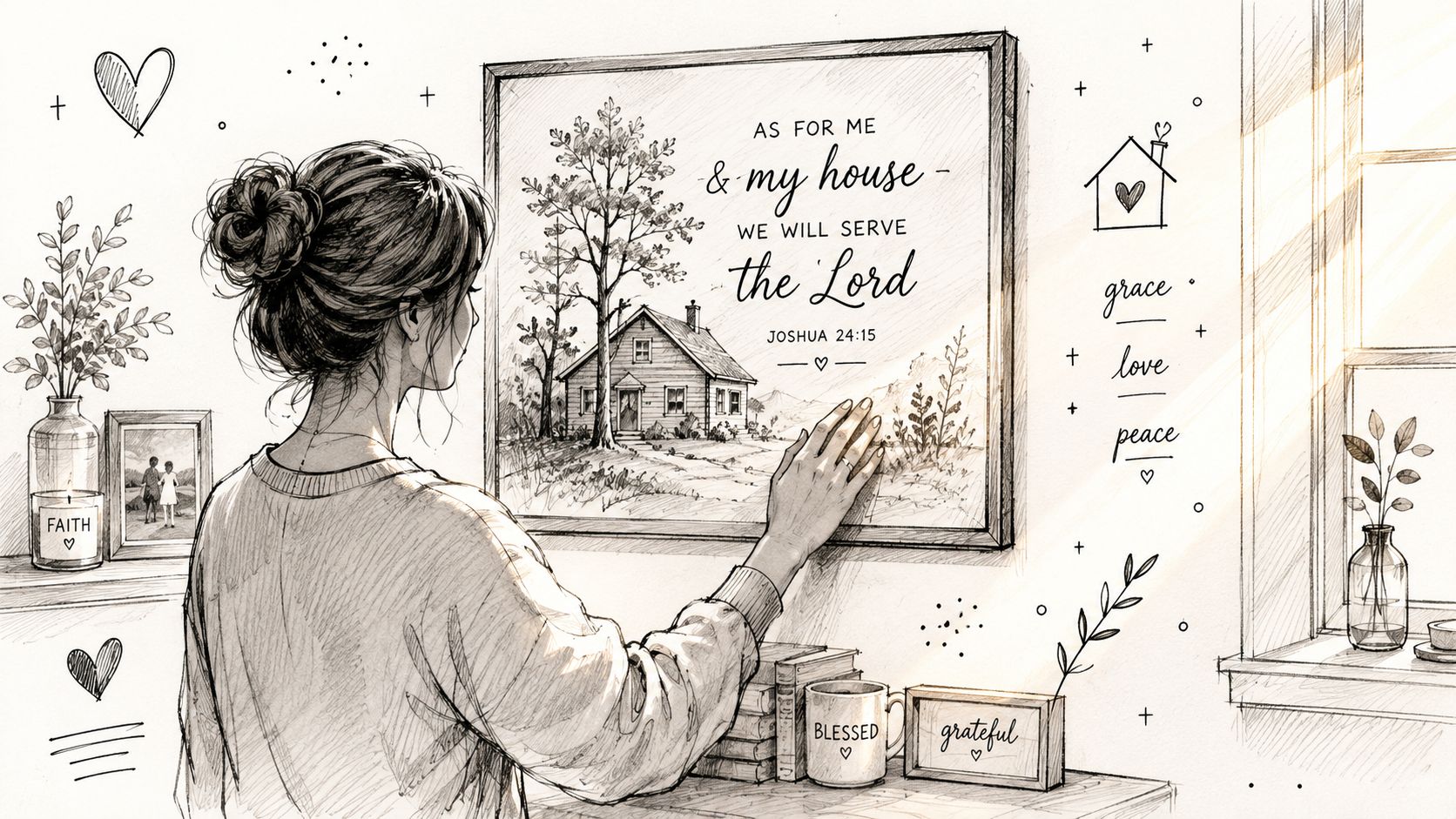
The homes people remember most are rarely the fanciest. They're the ones where the lamp by the chair was always on, where a Bible sat open near the place someone prayed each morning, where the artwork meant something because somebody chose it after a hard season, a wedding, a baptism, or a long-awaited answer to prayer. That kind of room has weight to it. It feels settled.
What makes it feel authentic
Southern homes have always understood something the decorating world sometimes forgets. Beauty is strongest when it serves memory, welcome, and daily life. A framed verse over the piano means more when the piano belonged to your grandmother. A handmade wooden cross carries more dignity on a limewashed wall beside family portraits than it does floating alone in a sea of mass-produced signs.
That's why faith based home decor works best when you treat it as curation, not theme decorating. You're not trying to prove you're faithful. You're trying to build a home that supports faithful living.
A good room should tell the truth about the people who live there.
A few signs you're on the right track
- Your pieces connect to real life. Baptism photos, a hymn lyric from your wedding, or art tied to a season of healing will always outlast trend decor.
- The room still functions well. Faith-filled spaces should feel lived in, not staged to the point nobody can breathe.
- Your style stays consistent. If your home leans collected, simple, and old-soul, your devotional pieces should follow that same language.
Some homes whisper faith. Some speak it plainly. Either can be beautiful. What matters is that the room feels rooted, not borrowed.
What Is Southern Faith-Based Interior Style
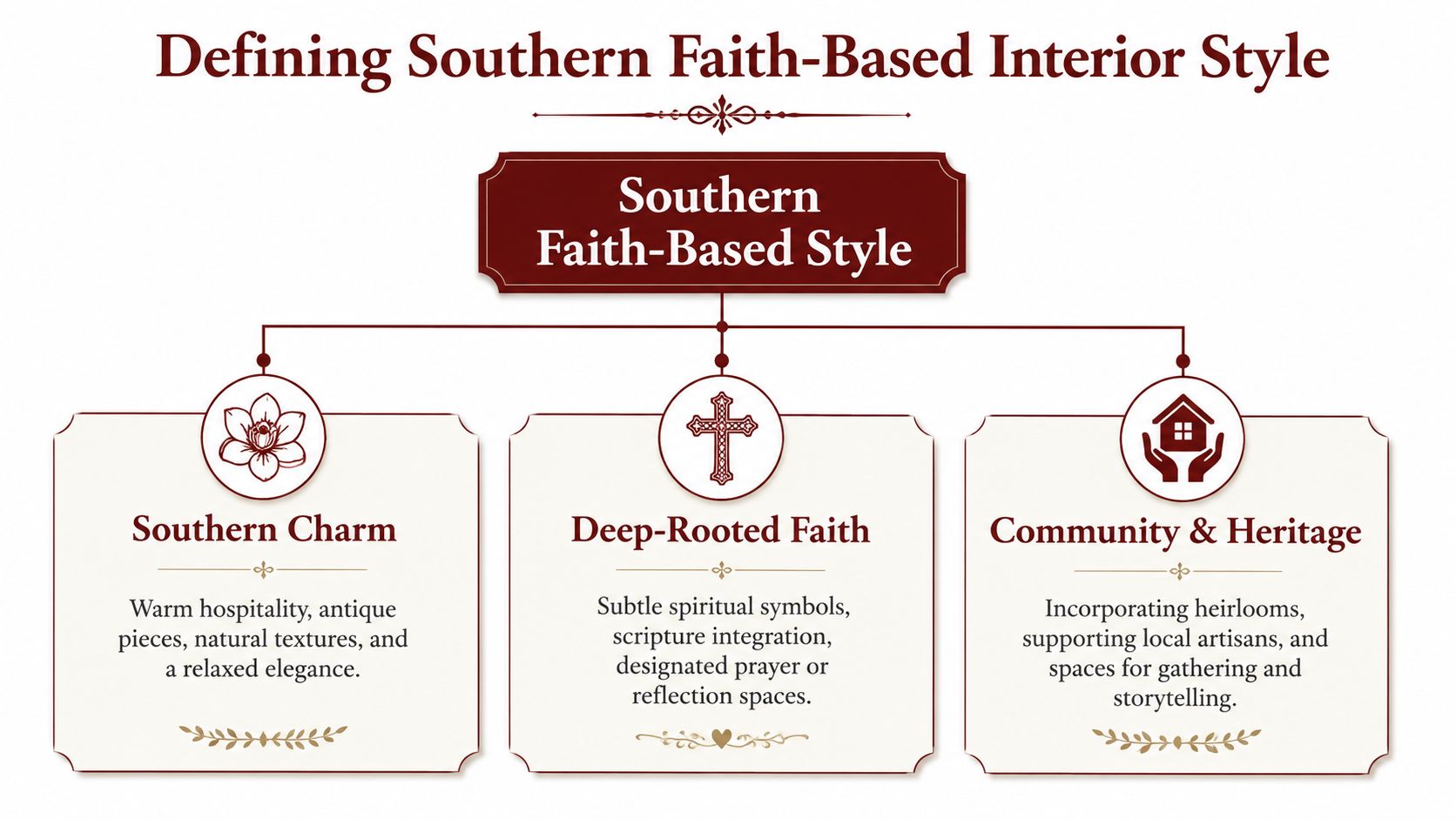
Southern faith-based interior style is not farmhouse with a Bible verse added at the end. It's warmer, older, more personal, and often far more restrained.
At its best, this look blends heritage, hospitality, and reverence. It honors the Southern instinct to gather people well. It makes room for family history. It draws from natural materials that age with dignity. And it treats spiritual symbolism with enough care that it doesn't slip into cliché.
What it is and what it isn't
There's a real appetite for styles beyond the usual distressed-white farmhouse approach. Homestyler's discussion of Christian decor trends notes rising searches for “Christian home decor that isn't farmhouse” and points to interest in minimalist, organic, and contemporary styles, along with a turn toward organic materials symbolizing renewal and purchasing with purpose.
That matches what shows up in real homes. People still want faith in the room. They just don't want it to feel stuck in one narrow visual formula.
Here's a plain comparison:
| Approach | Usually works | Usually falls flat |
|---|---|---|
| Southern heritage style | Antique wood, linen, iron, quiet symbolism, heirlooms | Too many matching slogan signs |
| Modern organic style | Stone, soft neutrals, handmade pottery, one strong spiritual focal point | Overfilling the room with repeated motifs |
| Contemporary Southern style | Clean lines, collected art, meaningful objects with breathing room | Mixing sleek furniture with overly kitschy word art |
The three marks of the style
Authenticity over perfection
Southern faith-based rooms shouldn't look too polished to live in. A prayer bench with a worn cushion, a handmade bowl on the table, or a stack of family Bibles tells a richer story than decor chosen only for color matching.
Storytelling through objects
Not every item has to be overtly religious. A framed letter, old church pew, mission-trip photo, or botanical print with scriptural significance can hold faith subtly yet powerfully.
A grounded connection to place
The South does this naturally when it's done well. Pine, oak, linen, cotton, clay, iron, and stone all feel at home here. They give spiritual pieces a sense of permanence.
Design test: If you removed the verse or cross, would the object still feel beautiful in your home? If the answer is no, it may be decorative filler instead of a meaningful piece.
The difference between “tacked on” and “woven in” is usually this simple. Woven-in faith looks like it belongs to the family. Tacked-on faith looks like it came from a trend shelf.
The Key Materials and Motifs of Heritage Decor
A room can carry faith without looking busy. The secret is choosing materials with age, texture, and a little hush to them.
Southern heritage decor leans on things that feel honest in the hand. Not slick. Not overly shiny. Not manufactured into sameness. If you want faith based home decor to feel enduring, start with the bones of the room and the surfaces your pieces will live on.
Materials that hold the look together
- Reclaimed wood brings warmth and history. It works beautifully for crosses, framed scripture, shelves, and statement pieces because the grain already carries character.
- Wrought iron adds structure. Use it in sconces, curtain rods, candleholders, or a bench base when you need contrast against softer fabrics.
- Linen and cotton keep the room breathable. They soften stronger symbolic pieces and prevent the space from feeling heavy.
- Aged metal and brass belong in small doses. A little tarnish or patina often looks better here than a bright polished finish.
- Stone and clay help modernize faith decor. They ground the room and pair well with simple symbols rather than overly ornate ones.
For homes that already lean rustic and outdoorsy, some of the same instincts used in hunting cabin decor ideas for layered natural texture translate surprisingly well to heritage faith styling. The difference is restraint. A faith-filled home needs warmth, not visual noise.
Motifs worth using with care
Instead of filling every surface with full verses, choose symbols that can breathe.
Short words with weight
Grace. Mercy. Gather. Abide. Peace.
Single words can do what long phrases often can't. They leave room for contemplation and don't dominate the architecture of the room.
Hymn fragments and liturgical language
A line from a beloved hymn often feels more intimate than a trendy saying. It signals faith with depth and memory attached to it.
Botanical symbolism
Magnolia branches, olive leaves, dogwood references, wheat, and vines all carry spiritual resonance without becoming literal. They also fit Southern interiors naturally.
Family identity worked into faith
A monogram near an entry table, a family date stitched on linen, or a cross integrated into heirloom framing can say far more than a stock sign ever will.
Practical rule: Pick one primary motif per room. If the room already has a cross as the focal point, let the textiles and accessories support it rather than compete with it.
What doesn't work nearly as well is piling on every available symbol at once. Crosses, doves, lambs, verses, angels, crowns, and word art in a single space usually make the room feel crowded before a guest ever sits down.
Styling Your Faith Room by Room
A whole house doesn't need to declare itself all at once. The prettiest Southern homes let faith unfold gradually, from the front door inward.
Start with one room that matters to your daily rhythm. Get that right, then carry the same language to the next space.
The entry that sets the tone
The entry should feel gracious, not crowded. A narrow console, a lamp with a soft shade, a shallow bowl for keys, and one meaningful piece of art is enough.
If you like a blessing at the door, choose one that suits your architecture. In a brick cottage, a carved wood plaque may feel right. In a cleaner, newer house, try framed calligraphy or a stone-textured piece instead.
For broader inspiration on mixing Southern character with cleaner lines, Southern interior design ideas with a heritage feel can help you think beyond one-note farmhouse styling.
The living room that holds both company and quiet
The living room is where many people overdo faith decor. They hang three verse signs, add matching pillows, then wonder why the room feels like a themed corner instead of a gracious gathering space.
Try this mix instead:
- One anchor piece such as a large scripture print, an antique cross, or a hymn-framed textile
- Two or three family elements like black-and-white portraits, baptism photos, or a wedding program in a small frame
- Everyday objects including candlesticks, books, pottery, and greenery to keep the room human
If you're hanging large art, placement matters. Heva Unique Art Gallery's guidance on Christian wall art placement recommends the center of a large piece at 145 cm (57 inches) for standard viewing, lowered to 110 to 120 cm (43 to 47 inches) over a seated prayer chair. The same guidance recommends warm-white lighting at 2700K to 3000K for a devotional atmosphere.
That little bit of care changes everything. Art that sits too high feels disconnected. Art at eye level feels companionable.
The kitchen and bedroom where faith stays close
In the kitchen, keep it practical. A small framed blessing near the breakfast nook, a devotional shelf beside cookbooks, or a linen towel with a hymn line is often plenty. This room works best when faith appears in the habits of the household, not just in wall coverage.
Later in the day, softer spaces matter even more.
In the bedroom, choose pieces that calm the mind. A verse about rest, peace, or steadfastness belongs here more than a loud declarative sign. Upholstered headboards, washed cotton, and bedside lamps with warm bulbs make the whole room gentler.
For a nursery, think blessing rather than branding. A framed prayer, a soft botanical print with scriptural meaning, or a child's name paired with a simple verse will age better than decor that feels too juvenile to last.
Decor as Discipleship and Hospitality
A home can teach without ever becoming preachy.
That's one reason faith based home decor matters more than many people realize. Children absorb what a house honors. Guests notice what a family keeps in plain sight. If your walls, shelves, and tables reflect gratitude, memory, prayer, and welcome, then decor stops being ornamental and starts becoming formative.
What discipleship looks like in a room
It often looks small. A framed verse by the breakfast table that your children hear read aloud. A gallery wall that includes baptisms, mission trips, grandparents, and church milestones. A chair in the corner that everyone knows is where Mama does her morning reading.
The Good Book's reflection on home decor and theology points to a growing desire for decor that avoids superficial prosperity-gospel tropes and repetitive stock phrases, while noting a rise in customizing decor with personal faith stories such as baptisms or mission-trip gallery walls. That's exactly the difference between shallow styling and meaningful testimony.
Better choices than the usual clichés
When choosing what to display, ask better questions than “What matches the sofa?”
Consider these:
- What has God brought our family through
- Which scriptures shaped this household
- What symbols would still feel honest ten years from now
- Which objects invite conversation instead of shutting it down
A home with depth doesn't need more words on the wall. It needs truer ones.
Choose fewer pieces, and choose them with more biography.
Hospitality with substance
Guests don't need a lecture when they walk in. They need a home where peace feels practiced.
That might mean a den arranged for conversation instead of screen dominance. It might mean a guest room with a small lamp, fresh water, and one quiet reminder of comfort and shelter. It might mean your dining room includes old family serving pieces and a framed blessing that reflects gratitude rather than performance.
People can tell when a room has been built around real conviction. They can also tell when the decor is trying too hard. Hospitality lands best when faith is present, settled, and generous.
Sourcing and Crafting Your Decor
The finest pieces are often the ones that don't arrive in a perfect matching set.
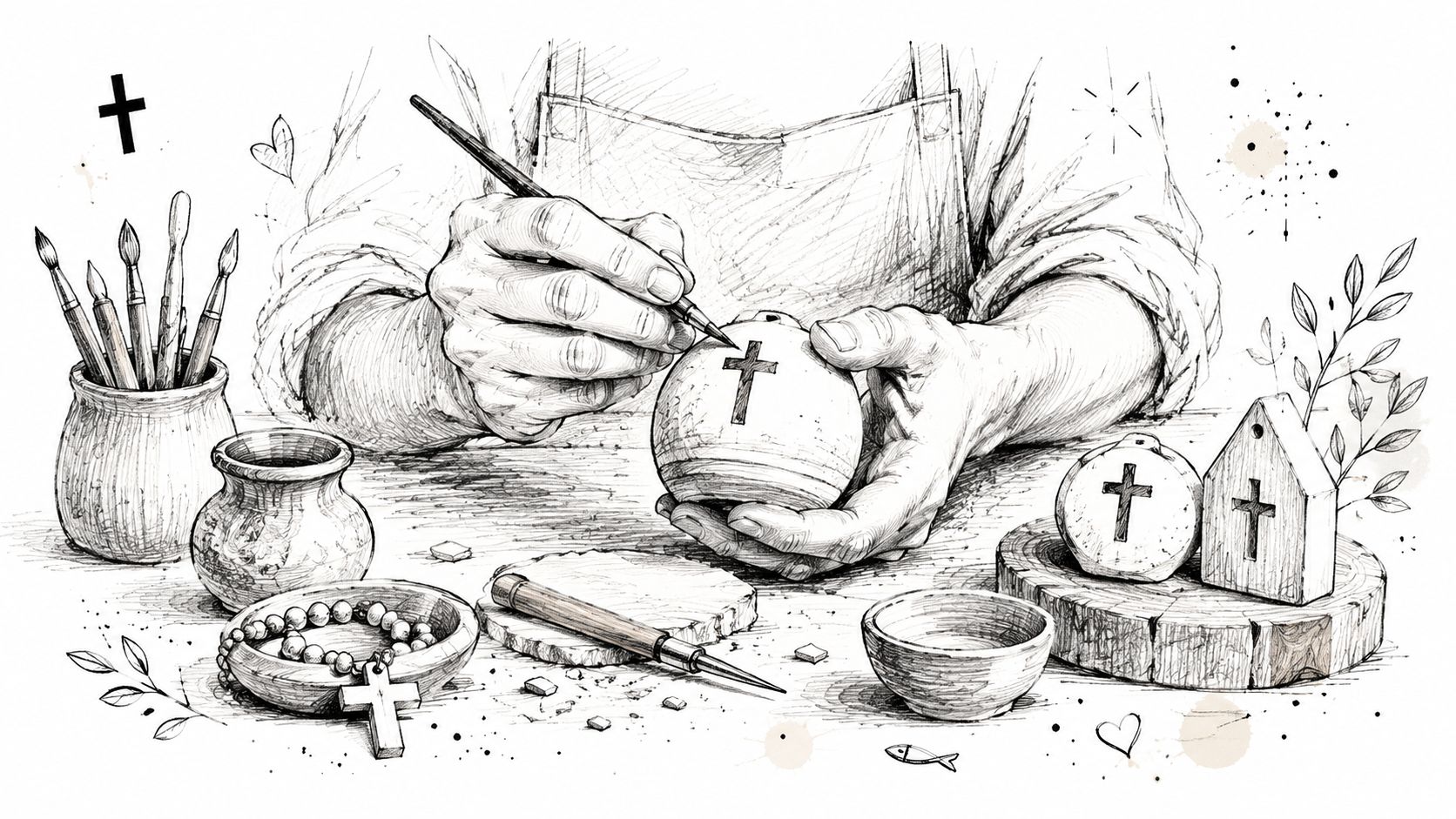
If you want a home with soul, source slowly. Buy from places where the object has some story left in it. That may be an antique store with old hymnals and carved frames. It may be a church rummage sale. It may be a local potter who can make a small vessel for olive branches. It may be your own attic.
Good places to look
A practical sourcing mix usually includes:
- Antique malls and estate sales for frames, side tables, candlesticks, church pew fragments, and old mirrors
- Local artisan markets for handmade crosses, pottery, linens, and carved wood pieces
- Thrift stores for baskets, brass, small stools, and picture frames you can repaint or re-mat
- Family storage for quilts, handwritten recipes, Bibles, letters, and formal portraits
If you enjoy scent as part of hospitality, home fragrance gift ideas with Southern character can help you think about candles and fragrance as part of the atmosphere, not just an add-on.
Simple projects worth doing yourself
Not every meaningful piece has to be expensive. Some of the loveliest items are assembled at the kitchen table.
Try one of these:
- Frame a family prayer or hymn in a mat that suits your room.
- Mount a baptism gown fragment or handkerchief in a shadow box.
- Paint a small wood plaque with one word instead of a long phrase.
- Create a restrained gallery wall using old photos, one piece of scripture art, and one natural object such as pressed greenery.
What to skip
There are a few purchases that often disappoint:
- Mass-produced signs with trendy fonts because they date quickly
- Pieces that shout louder than the room because they reduce reverence to novelty
- Cheap materials pretending to be heirlooms because they rarely age well
A strong collected home usually has one handmade thing, one inherited thing, one humble thing, and one beautiful thing sitting in conversation together.
Placement and Care for Your Cherished Pieces
Faith decor should be treated like something worth keeping, because it is.
Humidity, glare, and careless cleaning can wear out even lovely pieces before their time. Alibaba's Christian-themed gifts care guidance notes that canvas prints and wooden crosses should be kept away from high-humidity zones and direct sunlight to prevent warping and fading. The same guidance notes that metal embellishments need jewelry-grade care, which means keeping them dry and cleaning them with a soft cloth to prevent oxidation in humid climates.
A few habits that help
- Keep canvas out of bathrooms and steamy kitchens if you want it to hold its color and shape.
- Hang wooden crosses away from harsh afternoon sun so the finish doesn't dry unevenly.
- Dust metal accents with a soft cloth instead of rough paper towels that can scratch or dull details.
- Place your most meaningful piece where you'll see it. Over a prayer chair, beside the breakfast table, or across from the bed often works better than an overlooked hallway.
The right placement gives a piece spiritual usefulness, not just visual balance.
A cherished object becomes part of family memory when it's both seen and cared for. That's how decor turns into inheritance.
If you're ready to bring Southern warmth, faith, and everyday beauty together, Southern Static Clothing Company offers a thoughtful mix of Southern-inspired lifestyle goods, including home accents, candles, and giftable pieces that fit comfortably into a heritage-minded home. Browse their collections when you want finishing touches that feel rooted in small-town character and lived values.