

Hunting Socks Men: Choose & Care for Peak Performance
Before first light, a lot of hunters are already making mistakes with their feet. They've got the right camo, the right layers, and a solid plan for wind and access, but they're standing in damp socks that bunch in the heel, trap sweat, and start rubbing before sunrise. By mid-morning, the hunt is competing with hot spots, cold toes, or that swampy feeling you can't ignore.
That's why hunting socks for men deserve more attention than they usually get. This isn't a tiny gear detail. The broader outdoor sock category reflects that demand, with the global adult outdoor sports socks market valued at approximately $5 billion USD, according to Market Report Analytics on the outdoor sports socks market. Hunters buy performance socks for practical reasons. They need moisture control, blister prevention, and steady warmth during long walks, long sits, and changing weather.
Southern terrain makes the choice even trickier. You may start in cold dew, cross muddy bottoms, then spend the afternoon in rising heat. Add scent control to the mix and many socks start to reveal trade-offs. Some smell better at first but wear out too fast. Others last longer but feel harsh or hold moisture.
Table of Contents
- Introduction to Hunting Socks for Men
- Understanding Materials and Fabric Blends
- Comparing Insulation and Thickness Ratings
- Evaluating Waterproofing and Scent Control Technologies
- Getting the Right Fit and Layering Strategies
- Caring for Performance Hunting Socks and Common Mistakes
- Choosing Socks for Southern Hunting Terrains
- Conclusion and Final Recommendations
Introduction to Hunting Socks for Men
A good pair of hunting socks changes how your whole day feels. If your socks keep your feet dry, your boots fit better, your stride stays cleaner, and your focus stays on sign, sound, and wind instead of irritation. If your socks fail, every step reminds you.
Men often buy socks by thickness alone. That's where confusion starts. Warmth matters, but so do fabric blend, seam quality, heel hold, drying speed, and how the sock behaves after repeated washes. A sock that feels plush in the package can still collapse inside the boot once sweat and friction get involved.
Southern hunters run into a specific problem that doesn't get enough attention. They want odor control for close-range conditions and multi-day trips, but they also need comfort that survives mud, boot abrasion, and repeated wear. That balance is harder than it sounds.
Practical rule: Don't judge hunting socks by softness in your hand. Judge them by how they manage moisture, stay in place, and recover shape after a full day in boots.
A simple way to think about socks is to treat them like the tire on a truck. The truck does the heavy work, but the tire is what touches the ground every second. Your boots get the attention. Your socks do a lot of the quiet work.
The best hunting socks men can buy usually solve five problems at once:
- Moisture control so sweat moves away from skin instead of pooling.
- Friction control so heel and toe hot spots don't become blisters.
- Temperature regulation so feet don't swing from clammy to cold.
- Fit stability so material doesn't slide or bunch inside the boot.
- Reasonable durability so performance doesn't vanish after hard use.
Understanding Materials and Fabric Blends
Some socks fail because of bad construction. Many fail because the fiber mix was wrong for the hunt.
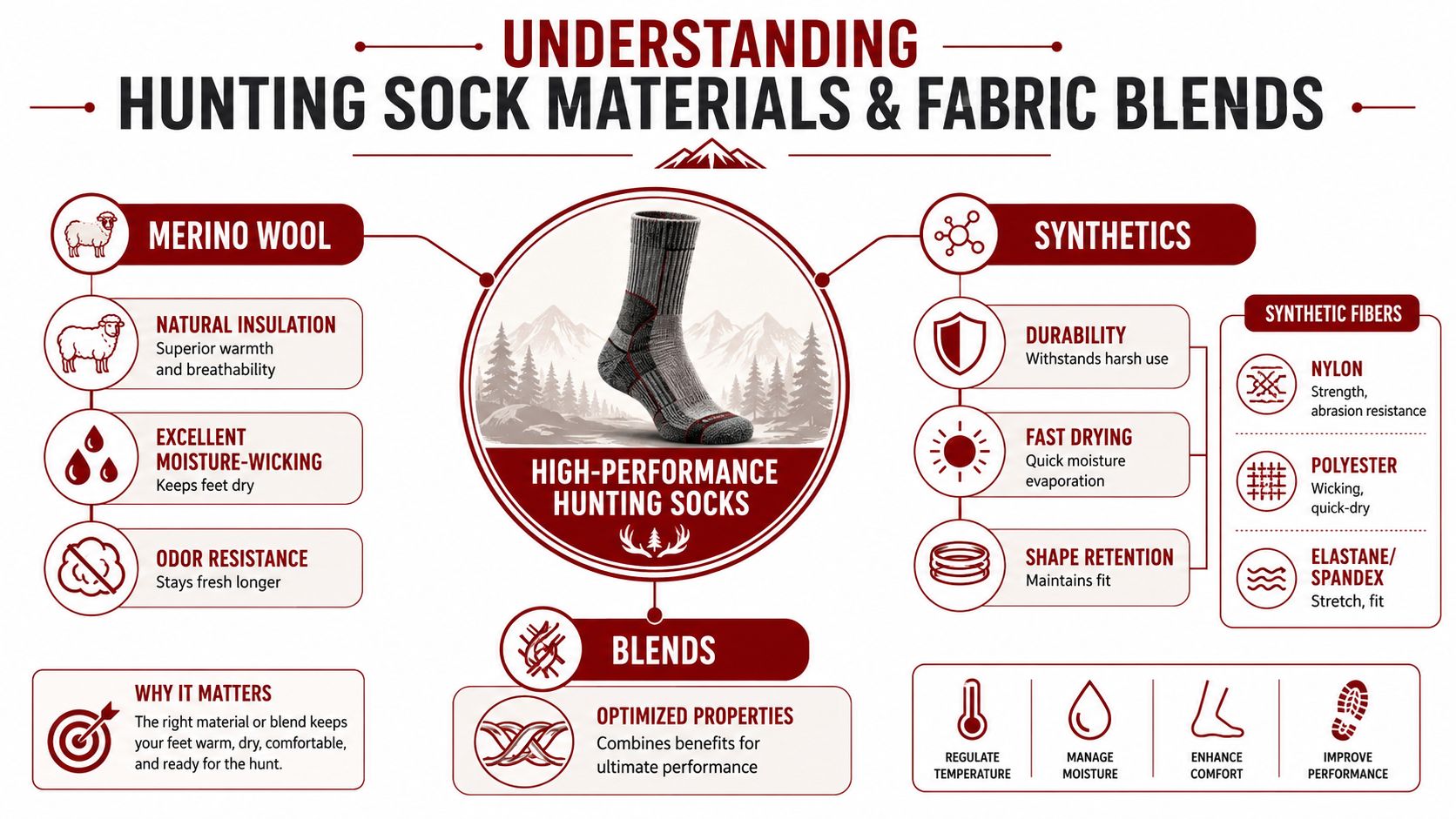
The strongest starting point for hunting socks men wear in cool or cold conditions is usually a Merino wool blend. Premium hunting socks often use 60% to 83% wool by weight, a range highlighted by Archery Hunting's field-tested guidance on hunting sock wool blends. That blend is valued because it can move sweat while holding warmth in cold conditions below 30°F, without sagging the way an overly soft sock can.
Why fiber content matters
Think of Merino wool like a sponge that still works even after it picks up moisture. It can absorb moisture without immediately feeling wet against your skin. That matters in a stand, on a stalk, or during a long drag when your feet heat up before the air does.
Wool alone isn't the whole story. A hunting sock also needs structure. That's where nylon or polyester comes in. These fibers help the sock resist abrasion from boot liners, heel slip, and rough trail movement. Without them, a soft wool sock can feel great at first and wear out too quickly.
A practical breakdown looks like this:
- Merino wool gives insulation, moisture handling, and better odor resistance than many basic fibers.
- Nylon adds toughness in the heel, toe, and high-rub zones.
- Polyester helps with moisture movement and drying speed.
- Elastane or spandex helps the sock hug the foot instead of sagging.
How to read a sock label
Many hunters get stuck on one question. Is more wool always better? Not always.
A very high wool content can sound ideal, but if the sock loses shape and slides in the boot, friction goes up. That defeats the purpose. On the other hand, too much synthetic content can make the sock feel less forgiving and less steady during long wear.
Use this quick label-reading approach:
- Check the wool percentage first. If you're dressing for colder hunts, that blend range above is a useful benchmark.
- Look for reinforcement language. Heel and toe durability matter more than marketing words on the front of the package.
- Notice the stretch fiber. A sock that doesn't recover shape won't stay put.
- Match the blend to your terrain. Wet, warm Southern conditions often call for a blend that dries and rebounds well, not just one that feels thick.
A hunting sock isn't one fabric doing one job. It's a team of fibers, each covering for the others.
Comparing Insulation and Thickness Ratings
Hunters often use the words warm and thick as if they mean the same thing. They don't. A thicker sock may feel warmer in your hand, but inside a tight boot it can reduce circulation, trap too much heat during movement, and create more rubbing if the fit gets cramped.
The better way to think about insulation is as part of a whole foot system. Sock thickness, boot volume, activity level, and weather all interact.
Thickness is really about boot system and activity
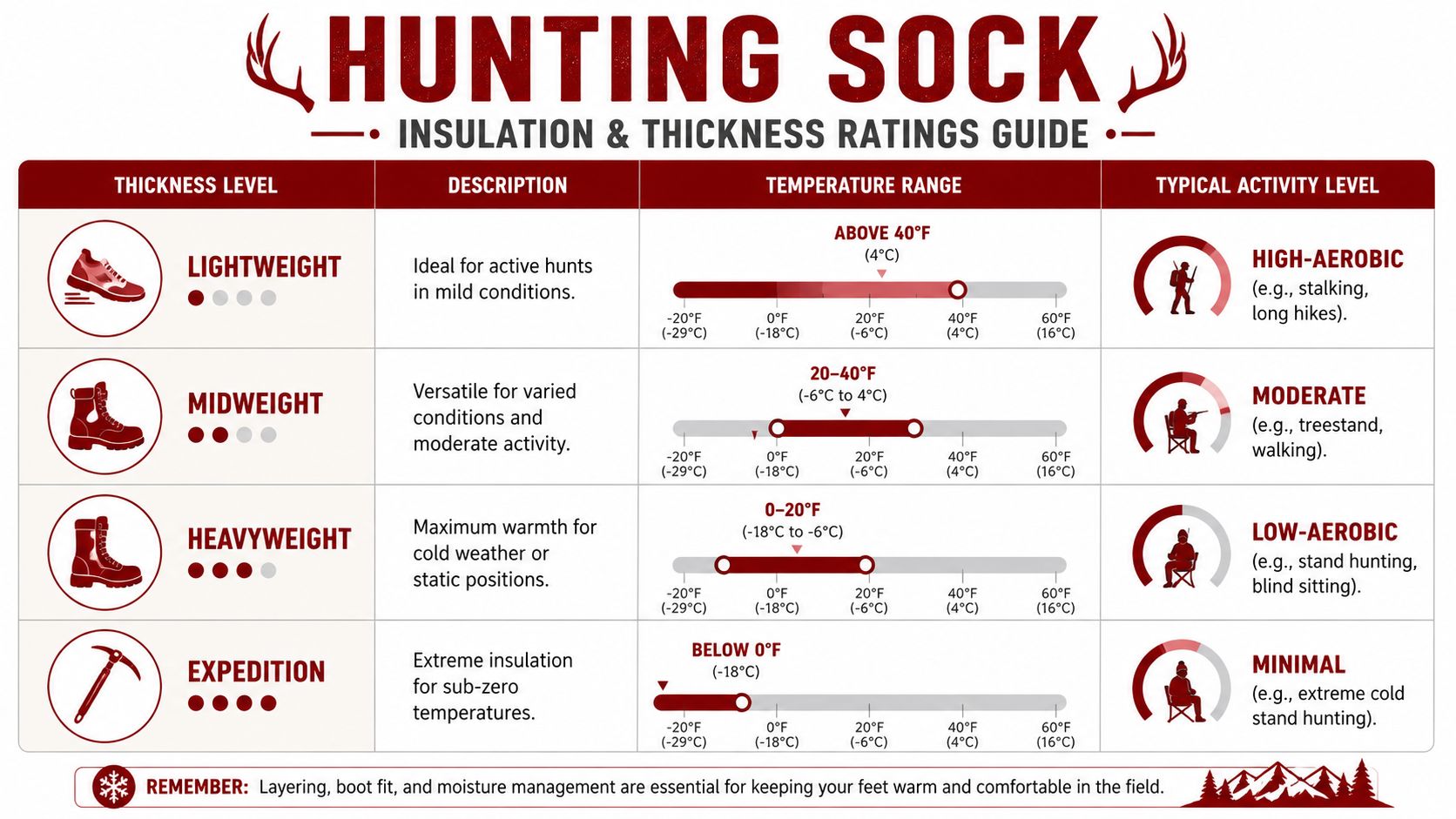
A lightweight sock works best when you're moving hard and generating heat. A heavier sock helps more when you're sitting, glassing, waiting, or hunting in deeper cold. Problems start when hunters buy one “winter sock” and expect it to work for every pace and every boot.
For example, a thin liner plus a medium outer sock often feels better than one very bulky sock. The liner manages moisture against the skin. The outer sock handles cushioning and warmth. That split is useful in Southern winters where the morning may be cold but the day warms up.
Sock Insulation Ratings and Use Cases
| Rating | Temperature Range | Best Use |
|---|---|---|
| Lightweight | Above 40°F | Active hunts in mild conditions |
| Midweight | 20-40°F | Mixed movement, varied terrain, moderate cold |
| Heavyweight | 0-20°F | Long sits, blinds, tree stands, low activity |
| Expedition | Below 0°F | Extreme cold and minimal movement |
A few simple rules help:
- Choose lightweight for stalking, climbing, and warm-weather movement.
- Pick midweight if your day mixes walking and waiting.
- Use heavyweight when you'll be still for long stretches.
- Reserve expedition weight for true deep-cold conditions, not just chilly mornings.
If your boots already fit snug, don't jump to a thicker sock as a fix for cold feet. Tight footwear can work against warmth by limiting space and comfort.
Evaluating Waterproofing and Scent Control Technologies
Southern hunts often involve wet grass, shallow water, mud, and humidity that hangs around all day. That makes waterproofing sound like the obvious answer. Sometimes it is. Sometimes it creates a new problem.
Waterproof feel versus breathable comfort
A waterproof sock or membrane-lined model can help when outside moisture is the main threat. Think flooded timber edges, marsh crossings, or hunts where splash and seep are constant. But extra waterproof barriers can also hold in heat and sweat. If your feet get wet from the inside, the comfort advantage disappears fast.
Natural odor resistance and treated scent-control approaches solve a different problem. They're meant to manage smell, not block water. Hunters often blur those categories together and end up disappointed. Waterproofing handles external moisture. Scent control deals with odor. One doesn't replace the other.
A practical way to compare them:
- Waterproof-focused socks fit hunts with repeated exposure to wet ground or standing water.
- Breathable wool-blend socks fit changing conditions where sweat management matters more than full water blocking.
- Treated scent-control socks may appeal for close encounters, but they should be judged on comfort and construction too.
The overlooked durability problem
Many hunting sock guides stop too early. They talk about scent blocking but not about how the sock holds up through rough use.
Consumer analysis highlighted by Mordor Intelligence on the socks market points to a clear gap. Technical hunting socks often lose integrity after 30+ days of field use, especially when heel and toe reinforcement or seam quality are weak. That matters for Southern hunters walking sandy trails, pushing through briars, and grinding the same pressure points day after day.
Watch for these signs of better long-term value:
- Reinforced heel and toe zones that resist boot friction.
- Flat, clean seams that won't start rubbing after the fabric softens.
- Consistent elasticity through the arch and cuff.
- Realistic scent-control expectations instead of assuming the treatment lasts forever.
If a sock promises scent control but the heel blows out early, the promise didn't help much.
For many hunters, the best answer isn't the most technical claim on the package. It's the sock that balances odor management with enough durability and comfort to survive repeated Southern use.
Getting the Right Fit and Layering Strategies
Fit is what turns good materials into real performance. Even a premium sock can cause trouble if it twists, bags up at the toe, or squeezes too tightly across the instep or calf.
Start with the foot, not the marketing label.
Fit first, then cushioning
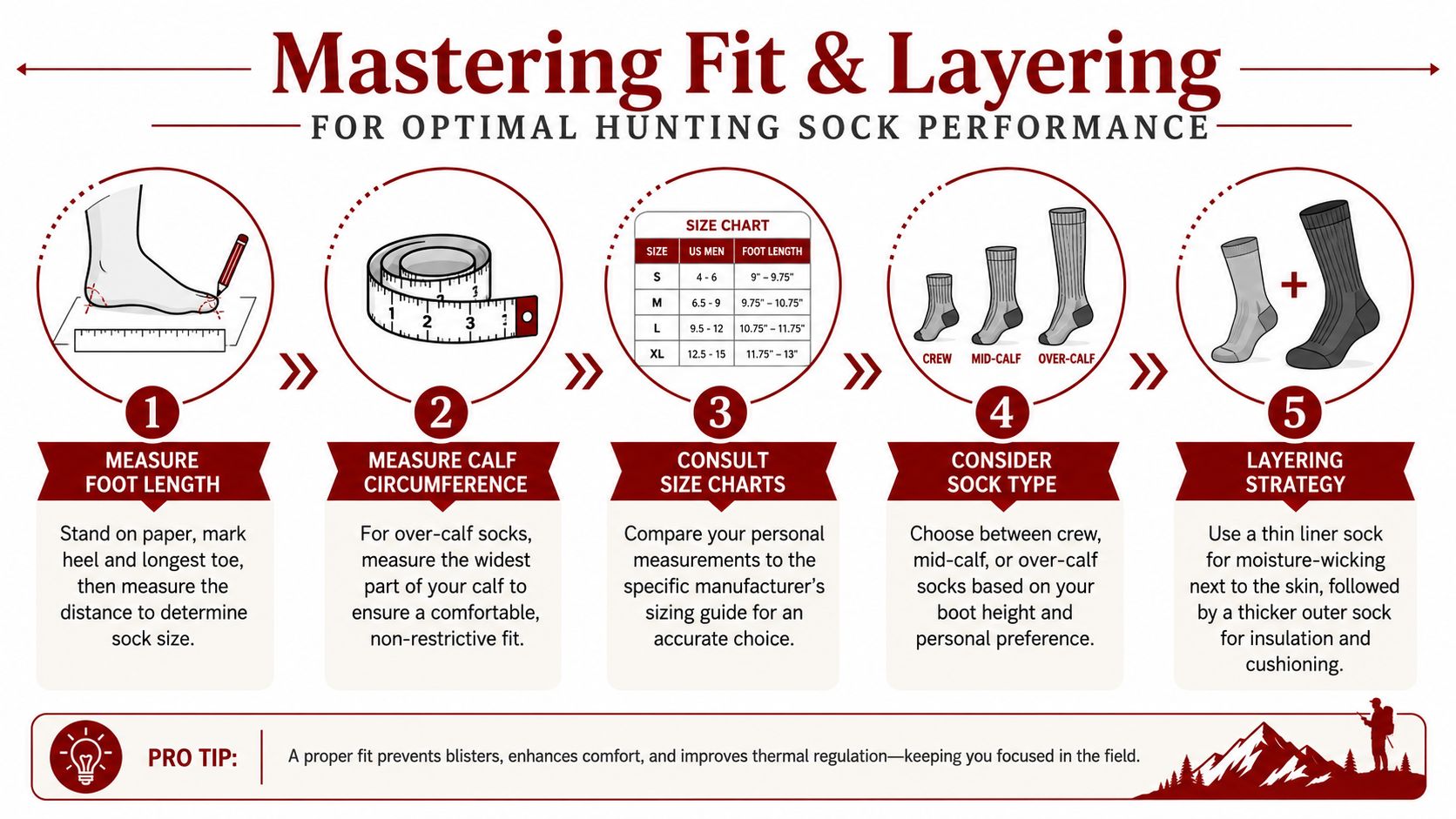
Measure your foot length while standing. If you wear over-calf socks, measure the widest part of your calf too. Then compare both numbers with the brand's chart. Don't assume your boot size automatically tells you your best sock size.
Three fit checks help before a hunt:
- Heel placement should sit exactly on your heel, not creep upward.
- Toe space should feel smooth, with no extra fold at the front.
- Cuff tension should stay up without leaving your lower leg feeling pinched.
Compression adds another layer of confusion. Consumer insights discussed by ShelfTrend's analysis of what sock buyers want show that compression socks in the 15–30 mmHg range are in strong demand, yet hunting content rarely answers the critical question. Do they help without restricting movement in insulated boots?
The safest practical view is simple. Compression may suit some hunters, especially those who like a more supported feel, but it shouldn't create pressure points inside a snug boot. If the boot already fits close, added compression can make the whole system feel crowded.
For a broader view of building a field-ready clothing system, this guide to outdoor men's gear is a useful companion read.
A visual walkthrough can help if sizing tends to trip you up.
Simple layering setups that work
Layering socks works like layering clothing. The layer closest to skin should handle moisture. The outer layer should handle cushion and insulation.
Try these combinations:
-
Early season setup
Thin single sock, especially if you're covering ground in warm or humid conditions. -
Fall mixed-condition setup
Thin liner under a midweight outer sock. This helps reduce friction and gives you room to adapt. -
Cold-weather sit setup
Moisture-wicking liner under a heavier outer sock, but only if your boots have enough volume. -
Wet Southern ground setup
Prioritize a sock that dries well and doesn't bunch once damp. Too much bulk becomes a liability in mud and heat.
Your boot should still feel like it was sized for your foot, not forced around your socks.
Caring for Performance Hunting Socks and Common Mistakes
A hunting sock can lose performance long before it looks destroyed. Wash it the wrong way often enough and the cushioning compresses, the stretch weakens, and the friction-control features stop working like they should.
That's especially important with engineered designs. FITS Sock Co. explains its sporting sock features, including Heel Lock, Dynamic Toe Cup, and full-foot cushioning, and notes that these features degrade when socks are washed in high heat or treated with fabric softener.
How to wash them without ruining performance
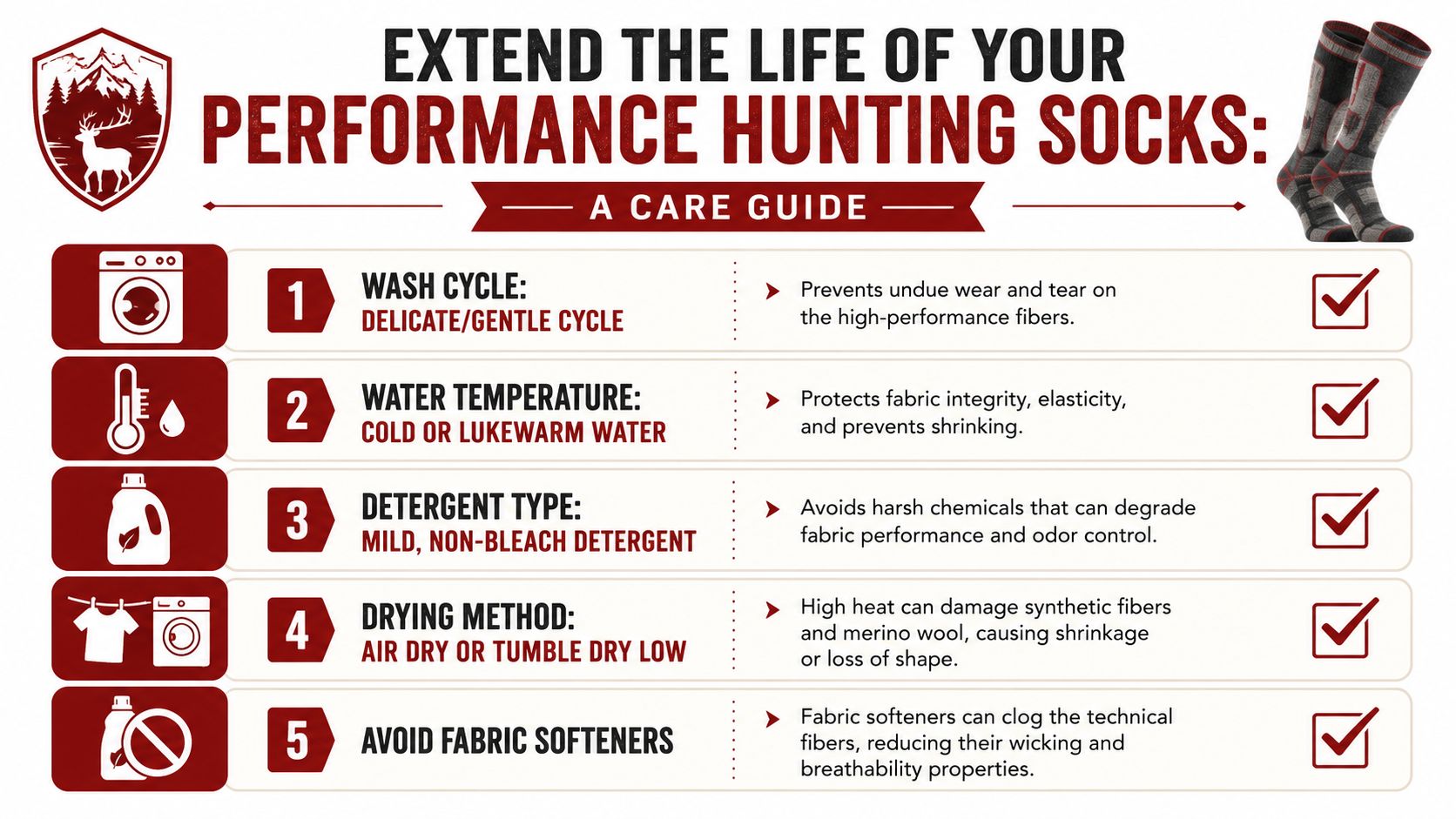
Use a gentle routine. That means mild detergent, cool or lukewarm water, and low-heat drying or air drying. The point isn't being precious. The point is protecting the fibers and the shape that keeps the sock stable in your boot.
A quick care checklist:
- Wash gently so the knit doesn't get beaten up.
- Keep water cool or lukewarm to protect wool and stretch fibers.
- Use mild detergent without harsh additives.
- Skip high heat because heat can distort shape and elasticity.
- Avoid fabric softener because it can interfere with wicking and breathability.
For another simple clothing-care reference, this article on how to wash graphic tees follows many of the same common-sense principles about protecting fabric over time.
Mistakes hunters make all the time
The biggest mistake is over-drying. Hunters toss technical socks into a hot dryer because it's fast, then wonder why the heel fit gets sloppy.
Other common errors include:
- Using fabric softener and accidentally reducing moisture management.
- Washing with rough gear like heavy zippers and abrasive workwear.
- Storing socks rolled too tightly until the cuff loses recovery.
- Ignoring thinning areas at the heel and toe until friction becomes obvious.
Clean socks aren't automatically ready socks. If heat damaged the structure, they may be cleaner and worse at the same time.
Choosing Socks for Southern Hunting Terrains
Southern terrain asks more from socks than many hunters expect. It's not just one condition. It's wet grass at daylight, sticky mud at mid-morning, sand or leaf litter by noon, and temperature swings all day.
Wet bottoms and swamp edges
In swampy ground, the key issue is often moisture overload. You need a sock that still feels stable after getting damp, not one that turns loose and squishy inside the boot. Good reinforcement at the heel and toe matters here because repeated wet friction can chew through weak spots fast.
If you'll face shallow water, marsh edges, or muddy crossings, look for:
- Quick-drying blends so the sock rebounds after exposure.
- Secure cuff and arch hold so the fabric doesn't slide once wet.
- Moderate cushioning instead of maximum bulk.
Pine woods, briars, and mixed ground
Piney woods and mixed Southern terrain create a different stress pattern. The issue isn't always standing water. It's long miles, grit in the boot, rough brush, and changing temperatures. A sock that breathes well and keeps a close fit usually does better than an overly padded one.
Two examples make the choice easier:
-
Duck hunter near wet cover
Lean toward a sock that manages moisture and maintains structure when damp. If waterproof layers are part of the system, avoid over-bulking the sock underneath. -
Spot-and-stalk hunter on sandy or uneven ground
Prioritize blister prevention, firm heel fit, and a blend that won't feel heavy as the day warms.
For Southern use, comfort and scent control need to coexist. A sock that smells fine but feels miserable in humidity isn't a win. A sock that feels great but breaks down quickly around the heel isn't either.
Conclusion and Final Recommendations
The best hunting socks men choose usually aren't the flashiest pair on the shelf. They're the pair that matches the hunt. Material, thickness, fit, odor management, and care all have to work together.
If you want a reliable decision framework, keep it simple:
- Start with the blend. A Merino-heavy blend is often the strongest base for cold and mixed conditions.
- Match thickness to activity. Don't use a heavy sock just because the morning starts cold.
- Treat scent control realistically. It matters, but comfort and reinforcement matter too.
- Dial in fit before layering up. Extra bulk can create the very problems you're trying to solve.
- Wash with care. Heat and fabric softener can degrade performance features.
For Southern hunting, that balance gets even more important. You're not only fighting cold. You're managing humidity, mud, changing ground, and long wear. That's why durability and comfort deserve as much attention as scent-control claims.
If you're shopping for hunting socks, think less about slogans and more about behavior. Does the sock stay put? Does it dry well? Does it still feel right after repeated use? Does it support the kind of terrain you hunt?
A dependable pair of socks won't make a bad hunt good. But it can remove one of the most common reasons a good hunt turns miserable. If you're ready to compare field-ready options, browse outdoor performance socks and apply the same standards you'd use for any other serious piece of gear.
Southern Static Clothing Company offers Southern-inspired apparel and outdoor accessories for people who live close to the land and spend real time outside. If you're looking for hunting-ready styles, everyday outdoor wear, or practical gear accents that fit a Southern lifestyle, visit Southern Static Clothing Company.